The Offside Line: Why Position Alone Does Not Settle the Call
Understand the football offside line by separating a player’s position from involvement in play, so close calls make sense beyond simply being ahead.
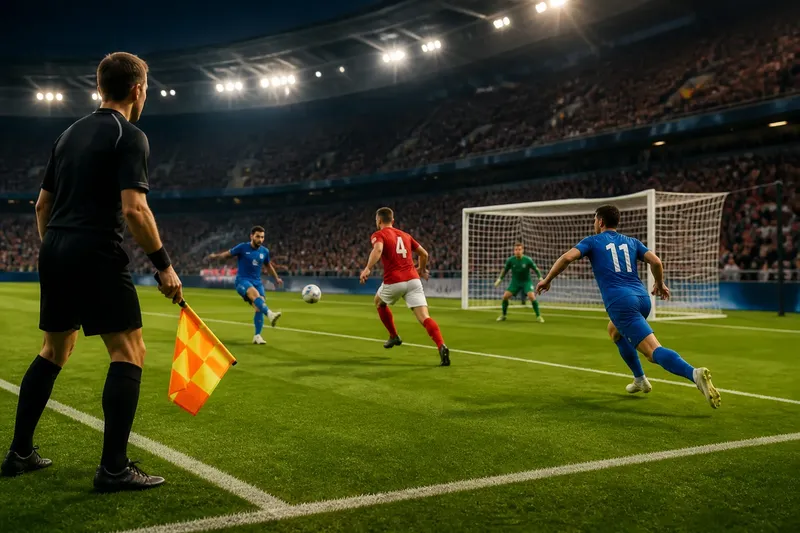
A winger sprints beyond the last defender, then stops as a teammate sends the ball through. The flag stays down. The confusion is understandable: the winger was plainly ahead, but football offside is not a penalty for standing in an advanced position. The call depends on where the player was when a teammate played the ball, and what that player did next.
To read the offside line, keep two questions apart: was the player in an offside position at the relevant moment, and did that player become involved in active play? Most arguments begin when those questions are treated as one.
Why does being ahead of the ball not settle offside?
A player is in an offside position if, when a teammate plays or touches the ball, the player is in the opponents’ half and nearer to the opponents’ goal line than both the ball and the second-last opponent. The goalkeeper may be one of those opponents, but is not automatically the last defender. The position is assessed at the instant the teammate plays the ball, not when it arrives or when the attacker runs on to it.
That position alone is not an offence. A forward can remain beyond the defenders while play moves elsewhere, provided they do not interfere with play, interfere with an opponent or gain an advantage from that position. Being ahead of the ball is only part of the positional test; it does not by itself answer whether the player is offside, since the defenders’ positions matter too.
There is no offside offence directly from a goal kick, throw-in or corner kick. Elsewhere, if the player was onside at the moment of the teammate’s touch, a later run past the defenders does not turn that pass into an offside offence.
What usually makes a close offside call look wrong?
- Watching the run instead of the pass. The attacker may look beyond the defence by the time the ball arrives. Check the moment of the teammate’s touch; that is when the positions are judged.
- Counting only the goalkeeper and one defender. The comparison is with the second-last opponent, not a fixed “last outfield player”. If the goalkeeper has moved forward, the relevant pair may look unusual.
- Assuming any forward pass is offside. The ball can travel forwards to a player who started behind it or behind the required opponents. Pass direction does not decide the call.
- Treating the flag as a judgement about intent. A player need not mean to interfere. The question is whether their position led to involvement in a way covered by the law.
Say a midfielder is about to pass while a striker stands beyond the second-last opponent, nearer the goal than the ball. The striker stays still and does not challenge anyone; a different, onside teammate collects the pass. Play continues because the striker’s position alone is not an offence. If the striker instead moves to contest the ball or obstructs a defender’s clear view, the decision may change.
How does a player become involved in play?
Active involvement usually falls into three practical categories. Interfering with play means playing or touching the ball passed or touched by a teammate. Interfering with an opponent can include obstructing an opponent’s line of vision, challenging for the ball, or clearly affecting the opponent’s ability to play it. Gaining an advantage can occur when a player plays a ball that rebounds or is deflected to them from an opponent, or comes back from a goal frame, after being in an offside position.
A defender’s deliberate play is not the same as a deflection. If an opponent deliberately plays the ball, that can reset the offside assessment, subject to the law’s qualification for a deliberate save. A ricochet or accidental touch does not simply wipe away the attacker’s earlier position. The distinction is about the nature of the opponent’s action, not whether the ball changed direction.
Some movements are less decisive than they look. A player can run near the ball without touching it and still be penalised if that movement challenges an opponent or otherwise affects their ability to play. Conversely, standing in an offside position near a defender does not automatically make the player guilty; the actual effect on play or the opponent matters.
Which questions help settle a disputed offside call?
When is the offside position judged?
Judge it when a teammate plays or touches the ball, not when the receiver controls it. A player’s position can change between those moments without changing the original assessment.
Does a level attacker count as offside?
No. A player level with the second-last opponent, or level with the ball, is not in an offside position. A television angle can make level positions look separated, so one frame or viewpoint may mislead.
Can a player be offside without touching the ball?
Yes, if the player interferes with an opponent in a way recognised by the law, such as blocking the opponent’s view of the ball. Merely being nearby or standing in an offside position is not enough on its own.
Does a defender’s touch always reset offside?
No. A deliberate play by an opponent can reset the assessment, but a deflection does not, and a deliberate save has a specific exception. If the broadcast does not make the action clear, the touch alone may not explain the ruling.
What should you check when the offside flag goes up?
Work through the decision in order rather than starting with the flag:
- Find the teammate’s touch. If the replay shows the instant the ball is played, use that frame; if it does not, do not treat the receiver’s later position as decisive.
- Locate the attacker. If the player is in the opponents’ half and nearer the goal line than both the ball and the second-last opponent, continue to the involvement check; if not, the player was not in an offside position.
- Look for involvement. If the player touches the ball, challenges or obstructs an opponent, or benefits from a rebound or deflection, consider whether the law’s involvement test is met; if none applies, position alone is not an offence.
- Check the source of the ball. If play began directly with a goal kick, throw-in or corner kick, there is no offside offence from that delivery; if an opponent played the ball, distinguish a deliberate play from a deflection or deliberate save.
- Separate what is visible from what is uncertain. If the camera shows the relevant touch and positions, use them to follow the sequence; if it does not, leave the exact timing or line unresolved rather than guessing from a different angle.
Imagine a fictional broadcast where a striker is level with the second-last opponent as a teammate touches the ball, then runs beyond the defence to collect it. The replay shows the touch, the level position and no intervening opponent play. The striker was not in an offside position at the relevant moment, so the later run does not make this an offside offence. If the same replay instead showed the striker clearly nearer the goal line than both the ball and the second-last opponent, the next question would be whether the striker became involved.
These checks are more useful than judging the whole incident from the attacker’s final position. On television, the camera may not show the relevant instant or the defenders on the same line; an assistant referee’s view and any available replay process may supply information the broadcast angle cannot. It is not worth pausing over every ordinary forward pass to count defenders. Save the close inspection for a flag, a goal disallowed after a run, or a pass where the attacker and defence appear nearly level.
The offside line becomes easier to read once the position and involvement tests are kept separate. For the next disputed football offside call, look first at the instant of the pass, then at what the player does. That order explains why an attacker can be far ahead and play can continue, while a player who never touches the ball can still be penalised.
One final distinction helps: the assistant referee’s flag is a signal for the referee, not an explanation of the decision. If the reason is unclear, identify which part of the sequence remains uncertain—the timing, the second-last opponent, or the attacker’s effect on play. That is a more productive question than asking only how far forward the player ran.