Man-to-Man or Zone: Two Ways to Defend Space
Man-to-man or zone defence assigns responsibility differently. Learn how to recognise each approach, spot handovers and understand the space an attack may target.

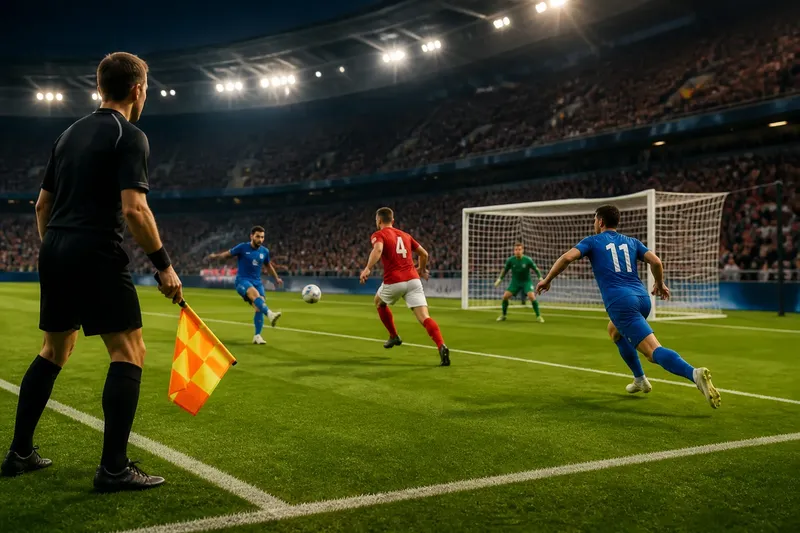
A forward drifts towards the edge of the penalty area, and a defender follows. Two teammates hold their positions; another points towards a runner arriving behind them. In the next phase, the forward moves on and the defender stays put. That change reveals the central difference between man-to-man and zone defence: one anchors responsibility to an opponent, the other to a part of the playing area.
The distinction matters because each system leaves different choices to resolve. A marker may follow a player away from a useful position; a zonal defender may need to decide whether a runner has entered their area or should be passed to a teammate. Neither system is a fixed answer to every attacking problem.
What does each defence ask a player to protect?
In man-to-man defence, each defender is assigned an opponent. The assignment may be strict, with the defender following that player across much of the playing area, or limited to a defined zone or phase. The opponent remains the main reference point: the defender tries to stay close enough to affect their next action.
In zone defence, each player is responsible for an area. Defenders watch opponents entering it, but their first obligation is to protect the space and respond to threats there. A runner may be tracked briefly, then handed to a teammate as the attack shifts across the field or court.
These are organising principles, not sealed boxes. A team can use zone principles while assigning one defender to a dangerous opponent. A marking defence can hand opponents over at boundaries. Terminology and rules vary by sport, so the same label does not always describe identical behaviour.
When can man-to-man make sense?
Marking can suit a situation where an identifiable opponent is the main source of danger: a skilful ball-handler, a powerful centre-forward or a receiver who repeatedly finds room. Giving a defender a clear assignment makes the responsibility easy to locate. If that opponent gets free, the marker has a direct problem to solve.
Close coverage can also disrupt an attack before its preferred sequence develops. It may deny a clean pass, contest a catch or make a player receive the ball in an awkward position. That pressure has a cost, however. If an opponent draws their marker away from a useful area, another attacker may find the space left behind.
Screens, crossing runs and sudden changes of direction force defenders to choose between following an assignment and protecting the team’s shape. The system also asks a marker to track their opponent while staying aware of the ball and other threats. Watching only the assigned player can leave a pass or cut unseen; watching only the ball can let that player slip away.
When can zone defence make sense?
Zone defence can suit an attack that threatens several spaces at once, or a defence intent on protecting a particular area. Players can keep a compact shape, help one another and make it harder to exploit a central gap. In basketball, defenders may close routes towards the basket while conceding a less dangerous shot farther away. In football, a defensive line may hold territory and pass runners between players rather than chase each movement across the pitch.
Because defenders are not automatically pulled along by every decoy run, a zone can help against attacks built on movement and passing. It can also divide responsibilities according to players’ strengths: one protects the centre, another an outside channel, and another watches for a late arrival. Those jobs still require judgement. Each player must recognise when a threat enters their area and communicate if a handover is needed.
The vulnerable points are the seams between responsibilities. An attacker can occupy a gap, arrive during a handover or draw two defenders towards the same threat. A zone that stays too narrow may concede space outside; one that stretches too far can expose the middle. The shape only holds if players move together.
How should a team choose its defensive approach?
Start with the attacking pattern, not the label. Is the danger mainly one opponent, a recurring route into space, or both? Then consider whether the defenders can communicate and move well enough to carry out the assignment.
- One opponent repeatedly creates danger: Check whether a defender can stay close without leaving another threat free. If so, give that player a marking assignment; if not, protect the threatened area with zone principles and help the marker selectively.
- The attack relies on crossing runs and decoys: Check whether defenders can recognise and communicate handovers. If they can, use zone principles to preserve the shape; if not, keep assignments simpler and make the handover rule explicit.
- The central area is the main route to a scoring chance: Check whether a compact shape can close that route without conceding an easy outside option. If it can, favour a compact zone; if it cannot, assign closer coverage to the central threat.
- The first pass or catch starts the attack: Check whether a marker can pressure it without being beaten into open space. If so, apply close coverage; if not, hold a protective shape and contest the next action.
- Players are mismatched in speed or strength: Check whether the mismatch pulls a defender away from a dangerous area. If it does, use a zone to limit that exposure; if one opponent remains the decisive threat, use a targeted marking assignment with nearby cover.
- The attack changes shape quickly: Check whether defenders can identify the change and pass responsibility cleanly. If they can, adapt the system with the attack; if they cannot, keep the basic rule clear rather than adding a second scheme they cannot execute.
These are decisions for a particular phase, not permanent identities. A team might begin in a zone, then mark more closely when the ball reaches a dangerous area. The useful question is which responsibility should dominate next.
What does a handover look like in practice?
Say a basketball team repeatedly sends a player across the key, the area near the basket. If a defender follows that player all the way and leaves their original opponent to a teammate, the defence is using a marking responsibility with a handover. If the defender stays near the basket and a teammate takes the moving player, the team is protecting space with zone principles.
Imagine a coach has two defenders who can stay close to a particular scorer, while the other three are more effective protecting the space near the basket. The coach starts with the defenders tracking that scorer and the others holding a compact zone. When the scorer cuts across the key, the nearest marker follows until a second defender calls the handover. The observable trade-off is clear: the scorer may receive tighter attention, while the defence has to communicate quickly to avoid leaving another attacker free.
The point of the example is not that the blended approach is automatically better. It shows how a team can assign responsibility to both an opponent and an area, and why the handover itself may be the moment an attack tries to exploit.
What questions help identify man-to-man or zone defence?
Does man-to-man mean a defender follows one opponent everywhere?
Not necessarily. Some teams use close tracking only in certain areas or phases, and many hand opponents over at a boundary. The defining feature is that opponents, rather than areas alone, anchor the assignments.
Does zone defence mean ignoring attackers?
No. Zone defenders watch the ball and opponents entering their area. They may challenge a player or track a run briefly, but their main responsibility is keeping their part of the defensive shape secure.
Can a team change from marking to zone during play?
Yes. A team can switch after a stoppage, in response to a formation or as the ball reaches a chosen area. Players need to recognise the cue and agree who takes each threat.
Which system is easier to recognise from the stands?
Man-to-man is often clearest when one defender visibly tracks an opponent. Zone is easier to recognise by watching the group: players shift together and pass runners across areas rather than following every movement.
What is not worth the effort?
There is little value in assigning a system from one glance. A defender looking towards an opponent does not prove the team is playing man-to-man, and a player holding position does not establish a zone. A single switch may answer an unusual movement rather than reveal the team’s usual plan.
To read man-to-man or zone defence, look for who owns the responsibility when an attacker crosses into a new space. An opponent may be followed, handed over or allowed to move on while the defender holds position. That choice shows how the defence is organised—and where its next difficult decision is likely to appear.