The Grip on a Ball: Texture, Shape and Control
Ball texture and shape help explain how players catch, carry and release a ball, and why different sports reward distinct kinds of control.
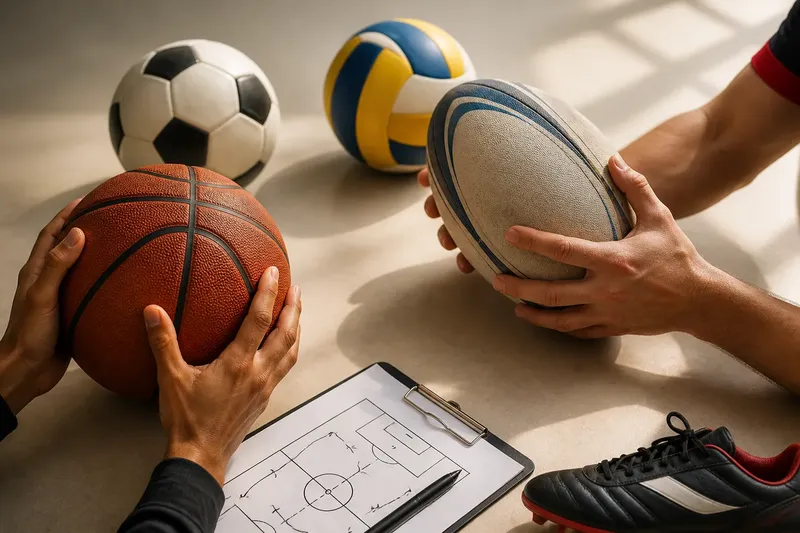
A rugby ball sits awkwardly in one hand while a basketball rests securely in two. Ball texture and shape influence how each is caught, carried and released, but the differences matter most when they meet a sport’s rules and habits.
Rather than treating grip as a single quality, compare what the ball is asked to do. A player may bounce, strike, catch or carry it; each action calls for a different kind of contact.
What does texture change?
Texture gives fingers and palms tactile cues. A basketball’s pebbled covering is easy to feel as a player guides a dribble, settles the ball for a pass or prepares a shot. It does not supply control by itself: hand position, timing and force still shape the result.
Football is mostly played with the feet, so the relevant contact is different. Panels and seams are part of the ball’s surface, but a player’s first touch also depends on foot position, pace and the angle of approach. In wet conditions, the feel of the ball and the contact may change; a close view of one touch rarely tells the whole story.
Where catching is central, a patterned surface can help a player feel the ball’s position in the hands. A player preparing to pass an oval ball may turn it before release, while a basketball shooter settles the ball against the fingertips. The routines reflect different releases, not a universal ranking of surfaces.
Why does shape affect handling?
A round ball can be handled in any direction, though its path still depends on the way it is struck and the spin it carries. Football and basketball make use of rolling, bouncing and passing a round ball through space.
An oval ball has a long axis and pointed ends, so its orientation matters. It can be tucked under an arm or turned deliberately for a pass. Its bounce is less regular than a round ball’s, which means players must react to where it goes rather than assume it will roll neatly.
Permitted balls and their specifications depend on the sport’s rules and the level of play. Shape and surface are not simply design preferences; they sit within equipment requirements that differ between competitions.
How do texture and shape work together?
Neither feature acts alone. A player’s grip, the ball’s orientation and the intended action combine. A textured surface may make contact easier to feel, while an oval shape makes orientation more relevant to carrying or passing. In a sport built around striking a round ball with the foot, those same features matter in another way.
Imagine a viewer watching a rugby match in which a player receives an oval pass while moving towards a defender. The starting situation is a fast pass arriving across the player’s body. The receiver brings the ball close, turns it into a position for a carry, then tucks it under an arm before contact. The observable result is a secure carry rather than an immediate pass; the trade-off is that the player has committed to running with the ball and has fewer options for an instant release.
What should you check when comparing balls?
Use the comparison to make a decision about what the design appears to support, not to diagnose every difficult touch. For each item, note the observation and follow the corresponding branch.
- Primary contact: Check whether players mainly use hands, feet or forearms. If the ball is mostly caught or carried, consider hand contact; if it is mainly struck, focus on the striking surface and approach.
- Shape: Check whether the ball is round or oval. If it is round, follow its bounce or roll; if oval, watch how players manage its orientation and react to its bounce.
- Surface cues: Check for visible seams or texture. If players use their hands, see whether they adjust their hold or release; if they do not, give more attention to the relevant foot or arm contact.
- Action after contact: Check whether the ball is caught, bounced, carried or redirected. If one action dominates, compare how players prepare for it; if several occur, keep them separate rather than treating grip as one explanation.
- Conditions: Check whether the surface or playing conditions appear wet. If so, allow for altered contact as one possible factor; if not, look first at movement, timing and the angle of arrival.
- Rules and level: Check which competition or level is being shown. If equipment requirements are unclear, consult the relevant governing rules; if they are known, compare only balls permitted in that setting.
What questions do viewers ask about ball grip?
Does a rougher ball always give players more control?
No. Texture can make contact easier to feel, but its relevance depends on the action, conditions and technique. In a sport where players mainly strike the ball, hand grip may explain little.
Why is a rugby ball oval?
The oval shape fits rugby’s carrying and passing, while affecting how the ball travels and bounces. Players must manage its orientation and respond to less regular bounces than they would expect from a round ball.
Does texture matter in football?
It can affect how the ball feels at contact, but first touch, foot position and the ball’s movement are central to control. Seams and panels are details to notice, not a complete explanation of a successful pass.
Should balls be compared by grip alone?
No. Shape, bounce, flight and the rules all affect what players can do with a ball. Compare how the whole design fits the sport’s handling demands instead.
Which details are worth noticing?
In basketball, watch how fingertips guide a dribble and how a player settles the ball before a pass. In football, follow the first touch and the angle of the foot. In rugby, notice how players carry and turn the oval ball, then respond when it bounces loose. In volleyball, players redirect the ball with their hands or forearms rather than holding it.
These distinctions show what texture cannot explain. The rules decide which forms of handling are allowed, while tactics determine when a player should attempt them.
What is not worth the effort?
There is little value in guessing a ball’s full specification from a broadcast close-up or treating every bobble as evidence of a surface problem. Camera angles, conditions and player movement can obscure the cause. It is more useful to connect a visible handling choice to the action the game demands.
Ball texture and shape are most revealing when considered together with the player’s task. A surface can offer a useful cue, and a shape can favour certain ways of carrying or releasing, but the game supplies the context. A missed touch may say as much about pressure and timing as it does about the ball.